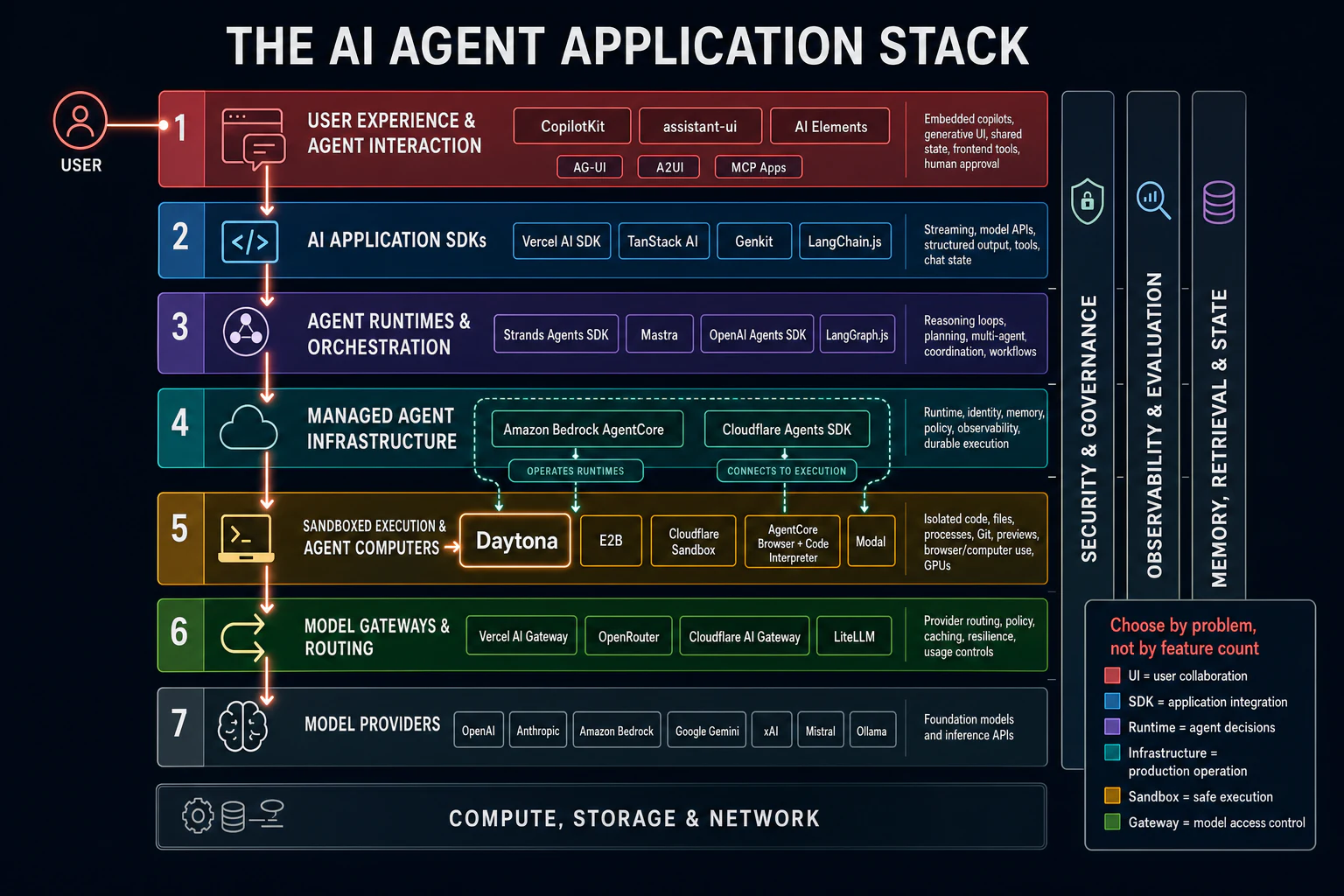
The AI Agent Stack: Architecture Layers and Market Map
Research date: June 15, 2026Scope: Active or influential open-source projects and commercial products with a public official website or repository.
How to read this map
There is no single “AI agent market.” There are several markets stacked on top of one another:
Agent products and hosts
User experience and agent interaction
Application and model SDKs
Agent frameworks and orchestration
Managed agent infrastructure and durable execution
Tools, integrations, protocols, retrieval, and memory
Sandboxed execution and computer use
Model gateways and routing
Model providers and inference runtimes
Compute, storage, and network
Security, identity, governance, observability, evaluation, and cost management cut across the entire stack.
Products often span several layers. This directory places each player where an architect would primarily evaluate or buy it. “Comprehensive” here means a broad, useful working set, not every GitHub repository or newly launched startup.
Layer 0: Agent products and hosts
This is the layer users operate directly. These products contain or connect to an agent runtime, but they are evaluated as finished coding agents, desktop agents, IDEs, assistants, or automation products.
Open-source and model-flexible coding agents
Player
Primary surface
What it is trying to solve
goose Desktop, CLI, API
Block's open-source, general-purpose local agent for coding, automation, research, workflows, MCP extensions, and multi-agent delegation
OpenCode Terminal, desktop, IDE
Provider-neutral open-source coding agent with a client/server architecture, LSP awareness, tools, permissions, agents, and MCP
Cline VS Code, CLI, SDK
Open coding-agent runtime with plan/action workflows, model choice, MCP, and embeddability
Roo Code VS Code
Open-source coding agent focused on configurable modes, tools, model choice, and extension workflows
Kilo Code IDE, CLI, cloud
Open-source coding-agent platform spanning local development, terminal use, cloud agents, and team workflows
Continue VS Code, JetBrains, CLI
Open-source coding-assistant platform for custom models, rules, context providers, autocomplete, and agents
Aider Terminal
Git-native pair-programming agent with broad model support and repository map/context management
OpenHands Web, CLI, SDK, cloud
Open platform for software-development agents, remote execution, evaluation, and delegation
SWE-agent CLI, research framework
Open software-engineering agent and benchmark-oriented environment from Princeton
Qwen Code Terminal
Open-source terminal coding agent optimized for Qwen but usable with compatible model endpoints
Gemini CLI Terminal
Google's open-source agentic terminal interface for Gemini and developer workflows
OpenAI Codex CLI, IDE, desktop, cloud
OpenAI's coding agent for local interactive work and delegated cloud tasks
Tabby IDE and self-hosted server
Self-hosted open-source coding assistant and completion platform
Zed Native editor
High-performance editor with first-party and Agent Client Protocol integrations
Open Interpreter Terminal and local computer
Open agent that lets language models operate code and the user's computer
Agent Zero Web/terminal agent
Open general-purpose agent with tools, subagents, memory, and local control
AutoGPT Agent platform
Open agent platform and visual system for creating and running autonomous workflows
Browser Use Library, CLI, cloud agent
Browser-operating agents and cloud browser automation
Commercial and vendor-native coding agents
Player
Primary surface
Center of gravity
Claude Code Terminal, IDE, web
Anthropic-native coding agent and agent SDK ecosystem
GitHub Copilot IDE, CLI, GitHub, cloud
Coding assistance, repository agents, reviews, issue-to-PR work, and multi-agent hosting
Cursor AI-native editor and cloud agents
Integrated coding, codebase reasoning, background agents, review, and team workflows
Windsurf AI-native editor
Agentic coding IDE with codebase context and workflow automation
Devin Cloud software engineer
Delegated autonomous software-development tasks in managed environments
Amazon Q Developer IDE, CLI, AWS console
AWS-oriented development, transformation, operations, and cloud assistance
JetBrains Junie JetBrains IDEs
Coding agent integrated with JetBrains project intelligence
Warp Agentic terminal
Terminal-native coding and DevOps agents with shared workflows
Amp Terminal and editor
Sourcegraph's agentic coding product for large codebases and delegated work
Replit Agent Browser IDE and hosted runtime
Prompt-to-application building, execution, and deployment
Bolt Browser app builder
Prompt-to-full-stack web application generation and deployment
Lovable Browser app builder
Conversational application generation with visual editing and deployment
v0 Browser and Vercel ecosystem
Generative UI and full-stack web application creation
Firebase Studio Browser development environment
Google/Firebase-oriented agentic application building
Mistral Vibe Coding agent
Mistral-native agentic software-development experience
Business and knowledge-work agent products
Layer 1: User experience and agent interaction
This layer turns backend agents into usable products. It handles chat, multimodal input, streamed events, generative UI, frontend tools, shared application state, approvals, and human intervention.
Agentic frontend frameworks and component systems
Player
Primary fit
CopilotKit Embedded copilots, AG-UI, generative UI, frontend tools, shared state, and human-in-the-loop interaction
assistant-ui Composable React chat and agent interfaces with runtime adapters
AI Elements Vercel/shadcn-style components for AI application interfaces
Chainlit Python-first conversational and agent application UI
Gradio Rapid Python interfaces for models, multimodal apps, and agents
Streamlit Python data and AI application interfaces
NLUX Framework-neutral conversational AI UI library
Stream Chat Production chat infrastructure and AI-agent messaging interfaces
Botpress Webchat Embeddable conversational-agent UI
Voiceflow Conversational and voice-agent design and prototyping
Self-hosted assistant shells
Player
Primary fit
Open WebUI Self-hosted multi-model and local-model interface
LibreChat Self-hosted multi-provider assistant platform
Chatbot UI Open-source conversational UI
LobeChat Open-source multi-provider chat and agent workspace
AnythingLLM Self-hosted chat, RAG, workspaces, and agents
Voice and realtime-agent interfaces
Player
Primary fit
LiveKit Agents Realtime voice, video, and multimodal agent framework
Vapi Voice-agent development and telephony platform
Retell AI Production phone and voice agents
Bland AI Phone-call automation agents
Pipecat Open-source realtime voice and multimodal agent framework
Daily Bots Realtime voice/video agent infrastructure
Layer 2: Interaction and interoperability protocols
Protocols are not agent frameworks. They standardize boundaries between hosts, tools, agents, user interfaces, commerce systems, and external services.
Protocol
Boundary it standardizes
Model Context Protocol (MCP) Agent/host access to tools, prompts, resources, and external context
Agent2Agent Protocol (A2A) Discovery, delegation, messaging, and task lifecycle between agents
AG-UI Event stream between agent backends and user-facing applications
Agent Client Protocol (ACP) Communication between coding agents and editors such as Zed
A2UI Declarative agent-generated user interfaces
MCP Apps Interactive UI resources delivered through MCP hosts
Agent Payments Protocol (AP2) Agent-initiated payments and commerce authorization
Universal Commerce Protocol (UCP) Interoperable commerce flows for agents and businesses
Agent Network Protocol (ANP) Decentralized agent discovery, identity, and communication
OpenAPI Machine-readable HTTP APIs commonly converted into agent tools
JSON Schema Structured tool inputs, outputs, and generated data
OpenTelemetry Vendor-neutral traces, metrics, and logs, including emerging GenAI conventions
Layer 3: AI application and model SDKs
These libraries normalize model access and application primitives such as streaming, structured output, multimodal input, tools, prompt management, and frontend state. Some overlap with the agent-runtime layer.
Player
Language/ecosystem
Center of gravity
Vercel AI SDK TypeScript
Full-stack AI applications, provider abstraction, streaming, tools, agents, and UI
TanStack AI TypeScript
Modular, type-safe provider adapters, tools, streaming, and application clients
Genkit JavaScript/TypeScript, Go
Full-stack AI flows, tools, evaluation, local development, and Google integrations
LangChain Python, JavaScript
Broad component ecosystem for models, tools, retrieval, agents, and chains
LlamaIndex Python, TypeScript
Data-centric AI applications, retrieval, workflows, and agents
Haystack Python
Production RAG pipelines, components, tools, and agents
Spring AI Java
Spring-native model, vector-store, tool, RAG, and agent application APIs
Semantic Kernel .NET, Python, Java
Enterprise application SDK for models, plugins, planning, and agent integration
Instructor Python and ports
Reliable schema-validated structured extraction from model outputs
BAML Multi-language
Typed prompt functions and structured model outputs
Outlines Python
Constrained and structured generation
Guidance Python
Controlled generation and prompt programming
LMQL Python/query language
Declarative constraints and programming over language models
DSPy Python
Declarative LM programs and prompt/module optimization
Layer 4: Agent frameworks, runtimes, and orchestration
This is the decision-loop layer. It coordinates models, tools, state, delegation, retries, approvals, and multi-agent workflows.
Code-first agent frameworks
Player
Primary design
Strands Agents SDK Model-driven agents, MCP/A2A, multi-agent Graph/Swarm, Python and TypeScript
OpenAI Agents SDK Agents, handoffs, guardrails, sessions, tracing, MCP, voice, and OpenAI-centric workflows
Claude Agent SDK Programmable access to Claude Code's agent harness and tools
Google Agent Development Kit Model-flexible agent development, multi-agent composition, sessions, and deployment
Microsoft Agent Framework Microsoft's successor path combining agent orchestration concepts from AutoGen and Semantic Kernel
LangGraph Stateful graphs, durable execution, interrupts, replay, and human-in-the-loop agents
CrewAI Role-based agent teams, crews, flows, and managed deployment
PydanticAI Type-safe Python agents with Pydantic validation and dependency injection
Mastra TypeScript agents, workflows, memory, RAG, evaluation, and development tooling
Agno Python agent framework with tools, teams, memory, knowledge, and runtime
smolagents Lightweight Hugging Face agents and code agents
LlamaIndex Workflows Event-driven workflows and data-aware agents
AutoGen Microsoft's established multi-agent framework; increasingly complemented by Microsoft Agent Framework
AG2 Community-led continuation of the AutoGen multi-agent ecosystem
BeeAI Framework IBM-backed open-source agents and multi-agent workflows
Letta Stateful agents with explicit memory architecture and long-running identity
Langroid Multi-agent Python programming framework
CAMEL-AI Multi-agent research and framework ecosystem
Atomic Agents Small, composable, schema-driven Python agents
VoltAgent Open-source TypeScript agent framework and observability ecosystem
mcp-agent Lightweight agent workflows centered on MCP
Rasa Enterprise conversational AI and controlled agent workflows
Visual and low-code agent builders
Player
Primary fit
Dify Open-source visual AI application, RAG, workflow, and agent platform
Flowise Open-source visual agent and LLM workflow builder
Langflow Python-based visual builder for agents, MCP, and RAG
n8n Workflow automation with AI agents and broad integrations
Botpress Visual conversational and customer-facing agent platform
Microsoft Copilot Studio Enterprise low-code agents in the Microsoft ecosystem
Vertex AI Agent Builder Google's managed agent and enterprise-search builder
Amazon Bedrock Agents AWS-managed agent building, action groups, knowledge bases, and multi-agent collaboration
Vellum Visual AI workflow, prompt, evaluation, and deployment platform
Stack AI Enterprise no-code agent and workflow platform
Retool Agents Agents connected to internal tools, databases, and applications
Zapier Agents Agents over Zapier's application and automation ecosystem
Layer 5: Managed agent infrastructure and durable execution
This layer runs and operates agents in production. It provides hosting, session isolation, identity, scaling, durable state, scheduling, deployment, and operational controls.
Player
Primary fit
Amazon Bedrock AgentCore Framework-neutral AWS runtime, memory, gateway, identity, policy, observability, browser, code interpreter, registry, and evaluations
Microsoft Foundry Agent Service Managed build, deployment, tools, tracing, identity, and scaling for agents on Azure
Vertex AI Agent Engine Managed runtime, sessions, memory, evaluation, and deployment on Google Cloud
Cloudflare Agents Stateful edge agents using Workers, Durable Objects, realtime connections, and workflows
LangSmith Deployment Managed deployment and operations for LangGraph applications
CrewAI AMP Managed enterprise deployment and operation of CrewAI agents
Mastra Cloud Managed deployment for Mastra applications and agents
Agentuity Agent-native cloud, development, deployment, routing, and observability
Blaxel Serverless agent infrastructure, sandboxes, functions, and model endpoints
xpander.ai Full-lifecycle, framework-neutral agent platform and control plane
Inkeep Agent builder, platform, and customer-facing agent deployment
Player
Primary fit
Temporal Highly durable, replayable, long-running workflows
Inngest Event-driven durable functions and agent workflows
Trigger.dev Long-running background jobs and AI tasks
Hatchet Open-source durable task and workflow orchestration
Restate Durable execution, virtual objects, and workflows
DBOS Database-backed durable workflows and application execution
Prefect Python workflow orchestration and data/AI pipelines
Dagster Data and AI asset orchestration
Apache Airflow Scheduled batch workflow orchestration
Agents need authenticated, governed access to business applications, APIs, browsers, search, and the public web.
Player
Primary fit
Composio Agent toolkits, managed authentication, and broad SaaS integrations
Arcade Secure agent tools, user authorization, MCP, and tool evaluation
Pipedream Developer integration platform, workflows, and MCP-connected APIs
Nango OAuth, credentials, API integrations, and agent connectivity
Klavis AI Hosted MCP infrastructure, tool discovery, and enterprise integration
Zapier MCP Agent access to Zapier's application ecosystem
Apify Web scraping, browser automation, Actors, and agent tools
Activepieces Open-source automation and MCP-enabled integrations
Paragon Embedded integrations and managed authentication
Merge Unified APIs and agent integrations for business software
Workato Enterprise integration, automation, and agent orchestration
Tray.ai Enterprise integration and agent connectivity
Make Visual automation and application integrations
Toolhouse Tool infrastructure, memory, and agent capabilities
Smithery MCP server registry, hosting, and discovery
Glama MCP server directory and hosting ecosystem
Search, research, crawling, and browser data
Player
Primary fit
Tavily Search and research API designed for agents
Exa Neural web search and research APIs
Firecrawl Website crawling, extraction, search, and agent-ready content
Jina AI Search, readers, rerankers, embeddings, and web data APIs
Parallel Web Systems Web research and data retrieval infrastructure for agents
Perplexity Sonar Search-grounded answer and research APIs
SerpAPI Structured search-engine result APIs
Bright Data Web data, scraping, proxies, and agent infrastructure
Oxylabs AI Studio Web intelligence, crawling, extraction, search, and browser-agent infrastructure
Diffbot Knowledge graph and structured web extraction
Layer 7: Sandboxed execution and agent computers
This layer gives agents isolated machines, filesystems, processes, browsers, desktops, code interpreters, and preview environments.
General code and computer sandboxes
Player
Primary fit
Daytona Framework-neutral programmable computers, snapshots, code interpreter, Git, previews, GPUs, Windows, and computer use
E2B Hosted secure cloud sandboxes and code interpreters for agents
Runloop Development environments and infrastructure for coding agents
Modal Sandboxes On-demand containers and sandboxes within a serverless compute platform
Vercel Sandbox Firecracker-based isolated execution integrated with Vercel
Cloudflare Sandbox Sandboxed code execution integrated with Workers and Containers
Fly.io Sprites Persistent, fast-starting remote computers for agents
Blaxel Sandboxes Serverless agent sandboxes and execution environments
Northflank Container infrastructure and isolated workloads for agents
Beam Serverless CPU/GPU execution and sandboxes
Freestyle Stateful agent computers and code execution
CodeSandbox SDK Programmatic development sandboxes and previews
Replit Hosted development environments and application execution
Azure Container Apps dynamic sessions Azure-managed isolated code-interpreter and custom-container sessions
AgentCore Code Interpreter AWS-managed isolated code execution
Browser and desktop computer-use infrastructure
Player
Primary fit
Browserbase Managed browsers, sessions, observability, and agent browser infrastructure
Steel Open-source browser API and managed browser infrastructure
Hyperbrowser Cloud browsers and web agents
Kernel Browser and computer infrastructure for agents
Browserless Hosted browser automation and Chrome infrastructure
Browser Use Cloud Managed browser-use agents and browser sessions
Anchor Browser Cloud browser infrastructure for agents
AgentCore Browser AWS-managed browser automation
Layer 8: Memory, retrieval, context, and knowledge
This layer turns stateless model calls into systems that can remember users, retrieve organizational knowledge, and maintain durable context.
Agent memory and context engines
Player
Primary fit
Mem0 User, session, agent, and graph memory as a framework or managed service
Zep Context graphs and enterprise agent memory
Letta Stateful agents with explicit working and archival memory
Cognee Knowledge graphs and memory for agents
Graphiti Temporal knowledge graphs for agent memory
Supermemory Universal memory and context API
LangMem Long-term memory tools for LangGraph agents
Hindsight Agent memory and retrieval system
EverMind Persistent agent memory platform
Memvid Portable file-oriented memory for AI applications
Retrieval and document processing frameworks
Player
Primary fit
LlamaIndex Data connectors, indexing, retrieval, workflows, and agents
Haystack RAG pipelines, document stores, retrievers, and agents
LangChain Retrieval components, loaders, splitters, vector stores, and agents
Unstructured Document ingestion, parsing, partitioning, and enrichment
LlamaParse Agentic document parsing
Docling Open document conversion and structured extraction
Vectorize Managed RAG pipelines and context engineering
Graphlit Multimodal knowledge ingestion, extraction, search, and agent memory
Vector and hybrid-search databases
Player
Primary fit
Pinecone Managed vector database and retrieval
Weaviate Open-source and managed vector/hybrid database
Qdrant Open-source and managed vector database
Milvus / Zilliz Distributed open-source vector database and managed cloud
Chroma Developer-focused open-source and hosted retrieval database
LanceDB Embedded and cloud multimodal/vector database
pgvector Vector search extension for PostgreSQL
Redis In-memory data platform with vector and hybrid search
Elasticsearch Search, hybrid retrieval, and vector database capabilities
MongoDB Atlas Vector Search Vector search within MongoDB
Vespa Large-scale search, ranking, recommendations, and vectors
Turbopuffer Serverless vector and full-text search
Supabase Vector Postgres/pgvector retrieval in the Supabase platform
OpenSearch Open-source search and vector retrieval
Layer 9: Observability, evaluation, testing, and prompt operations
Traditional logs tell you whether code crashed. Agent observability must also explain model decisions, tool calls, trajectories, quality, cost, regressions, and user outcomes.
Player
Primary fit
LangSmith Agent tracing, datasets, evaluation, prompt management, and deployment
Langfuse Open-source traces, evaluation, prompts, metrics, and self-hosting
Braintrust Evals, experiments, datasets, tracing, and production monitoring
Arize Phoenix Open-source OpenTelemetry-native tracing and evaluation
Weights & Biases Weave Tracing, evaluation, datasets, and model/application analytics
AgentOps Agent monitoring, replay, cost tracking, and evaluation
Helicone Gateway, observability, sessions, prompts, and evaluations
Opik Open-source tracing, evaluation, prompt optimization, and production monitoring
MLflow Open-source GenAI tracing, evaluation, prompt/version management, and deployment integration
Traceloop OpenLLMetry/OpenTelemetry-based LLM and agent observability
Parea Evaluation, testing, tracing, and experimentation
Galileo Agent evaluation, observability, guardrails, and quality intelligence
Patronus AI Evaluation, red teaming, and reliability
HoneyHive Evaluation, tracing, prompt management, and experiments
Maxim AI Simulation, evaluation, observability, and agent quality
Laminar Open-source tracing, evaluation, and data collection
LangWatch Open-source LLM/agent evaluation and observability
Lunary Open-source monitoring, prompts, analytics, and evaluation
Portkey AI gateway plus observability, governance, and prompt management
Evaluation and testing frameworks
Player
Primary fit
DeepEval Pytest-style evaluation for LLMs, RAG, and agents
Ragas RAG and agent evaluation
promptfoo Open-source testing, comparison, red teaming, and CI
Giskard Open-source LLM testing, evaluation, and security scanning
OpenAI Evals Open-source evaluation framework and registry
Inspect AI UK AI Security Institute's open-source evaluation framework
Evidently Open-source AI quality, testing, and monitoring
Fiddler Model and GenAI observability and governance
Arthur AI performance, monitoring, evaluation, and governance
Layer 10: Security, identity, guardrails, and governance
Agent security includes prompt injection, data leakage, unsafe output, excessive permissions, tool misuse, insecure MCP servers, identity delegation, policy enforcement, and auditability.
Runtime guardrails and open frameworks
Player
Primary fit
Check Point Lakera Prompt-injection defense, runtime guardrails, and red teaming
Protect AI AI supply-chain security, model scanning, red teaming, and LLM protection
Prompt Security Enterprise GenAI and agent security
Snyk / Invariant Labs Agentic AI and MCP security guardrails
HiddenLayer Model and AI runtime threat detection
Cisco AI Defense Enterprise AI discovery, validation, runtime protection, and governance
Palo Alto Prisma AIRS AI runtime security, posture management, and red teaming
Noma Security AI and agent security posture, red teaming, and runtime protection
Zenity Security and governance for enterprise agents and copilots
Pillar Security AI application discovery, testing, and runtime protection
Mindgard AI red teaming and security testing
CalypsoAI AI security, red teaming, and runtime controls
WitnessAI Enterprise AI visibility, policy, and security
Credo AI AI governance, risk, policy, and compliance
Holistic AI AI governance, risk management, and assurance
Identity and authorization for agents
Player
Primary fit
Auth0 for AI Agents User identity, token vaulting, and delegated authorization for agents
Stytch Connected Apps OAuth and machine/application authorization
WorkOS Enterprise identity and authorization infrastructure
Permit.io Fine-grained authorization and policy for applications and agents
Oso Authorization as a service and policy engine
Cerbos Open-source authorization and policy decision points
Open Policy Agent General-purpose policy engine
Layer 11: Model gateways, routers, and inference control planes
Gateways normalize providers and add routing, fallbacks, caching, budgets, keys, policy, logging, and usage control. They do not replace an agent runtime.
AI-native gateways and model routers
Player
Primary fit
OpenRouter Multi-provider model marketplace and routing API
Vercel AI Gateway Unified model access integrated with Vercel AI SDK and platform
Cloudflare AI Gateway Edge gateway, caching, logging, resilience, routing, and policy
LiteLLM Open-source OpenAI-compatible proxy and provider normalization
Portkey AI Gateway Gateway, routing, governance, observability, and prompt operations
Helicone AI Gateway Open gateway with routing and observability
Unify Performance/cost-aware model routing and unified API
Requesty Multi-provider routing, fallbacks, and observability
Martian Model routing and optimization
Not Diamond Model selection and routing
Eden AI Unified API across AI providers and capabilities
TrueFoundry AI Gateway Enterprise gateway, governance, routing, and self-hosting
API gateways with AI capabilities
Layer 12: Model providers, inference clouds, and local runtimes
This is where model inference occurs. Some providers sell proprietary models, some host open models, and some supply inference software for your own compute.
Player
Primary offering
OpenAI GPT, reasoning, realtime, image, audio, embeddings, and agent APIs
Anthropic Claude models and agent/coding ecosystem
Google Gemini Gemini models, multimodal APIs, and Google AI Studio
Amazon Bedrock Managed access to Amazon and third-party foundation models
Microsoft Foundry Models Azure model catalog and managed inference
Mistral AI Frontier and open-weight models and APIs
xAI Grok models and APIs
Cohere Enterprise language models, embeddings, and reranking
DeepSeek Reasoning, coding, and general models
Qwen Alibaba's open and hosted multimodal/model family
AI21 Labs Enterprise language models and orchestration
IBM watsonx.ai Enterprise model platform and Granite models
NVIDIA NIM Optimized model microservices and enterprise inference
Hugging Face Model hub, datasets, endpoints, and inference services
Hosted inference for open and custom models
Player
Primary fit
Together AI Hosted open-model inference and fine-tuning
Fireworks AI Fast hosted inference, fine-tuning, and compound AI
Groq Low-latency inference on LPU hardware
Cerebras Inference High-speed model inference
SambaNova Cloud Enterprise model inference and platform
Replicate Hosted model execution and deployment
Baseten Production model inference and deployment
Modal Serverless model and GPU workloads
RunPod GPU cloud, serverless inference, and endpoints
CoreWeave GPU cloud and AI infrastructure
Lambda GPU cloud and training/inference infrastructure
Self-hosted inference runtimes
Player
Primary fit
Ollama Simple local model runtime and API
vLLM High-throughput open-source serving engine
SGLang High-performance serving and structured generation runtime
Hugging Face Text Generation Inference Production serving for Hugging Face models
llama.cpp Efficient local inference across CPUs and GPUs
LM Studio Desktop local-model discovery, execution, and API server
LocalAI OpenAI-compatible local inference stack
NVIDIA TensorRT-LLM NVIDIA-optimized LLM inference
KServe Kubernetes-native model serving
BentoML Model packaging, serving, and deployment
Layer 13: Compute, storage, network, and deployment substrate
Every upper layer eventually runs on conventional infrastructure. The agent ecosystem does not remove this layer; it adds more dynamic workloads, secrets, egress, state, and isolation requirements.
Category
Representative players
Hyperscale cloud
AWS , Microsoft Azure , Google Cloud , Oracle Cloud
Edge/serverless
Cloudflare , Vercel , Fastly , Netlify
Application platforms
Fly.io , Railway , Render , Heroku , Northflank
Containers and orchestration
Docker , Kubernetes , Nomad , OpenShift
Databases and object storage
PostgreSQL , Supabase , Neon , MongoDB , S3 , Cloudflare R2
Messaging and streaming
Kafka , Redpanda , NATS , RabbitMQ , Confluent
Secrets and key management
HashiCorp Vault , AWS Secrets Manager , Azure Key Vault , Google Secret Manager , Infisical
Where Goose and OpenCode sit
Goose and OpenCode are best understood as agent products/hosts , not merely SDKs:
User
  |
  +-- Goose desktop / CLI / API
  |     +-- agent loop
  |     +-- model-provider adapters
  |     +-- MCP extensions
  |     +-- built-in code and shell tools
  |     +-- recipes, scheduling, subagents, and ACP delegation
  |
  +-- OpenCode terminal / desktop / IDE
        +-- client/server agent architecture
        +-- model-provider adapters
        +-- LSP-aware coding tools
        +-- permissions and custom agents
        +-- MCP and SDK integration
They compete most directly with Claude Code, Codex, Gemini CLI, Cline, Roo Code, Kilo Code, Aider, Continue, and OpenHands. They do not directly replace an agent deployment platform such as AgentCore, a sandbox such as Daytona, a frontend framework such as CopilotKit, or a gateway such as LiteLLM.
Goose is broader and more automation-oriented: it is positioned as a general-purpose local agent with recipes, extensions, scheduling, and the ability to conduct other agents through ACP. OpenCode is more deliberately centered on the terminal/IDE software-development experience and a provider-neutral client/server architecture.
Common stack combinations
Open-source local coding agent
OpenCode or Goose
  -> MCP tools
  -> OpenRouter or LiteLLM
  -> Anthropic, OpenAI, Gemini, Qwen, or local Ollama/vLLM
Embedded enterprise copilot
CopilotKit
  -> LangGraph, Strands, Microsoft Agent Framework, or OpenAI Agents SDK
  -> Composio, Arcade, or internal MCP servers
  -> Mem0, Zep, or a vector database
  -> AgentCore, Foundry Agent Service, or Vertex Agent Engine
  -> model gateway
  -> model provider
Secure coding or data-analysis agent
Product UI
  -> agent framework
  -> Daytona, E2B, Runloop, or another sandbox
  -> repository, data, tests, and preview server
  -> observability and evaluation platform
  -> gateway and models
Fully self-hosted stack
Open WebUI or LibreChat
  -> LangGraph, PydanticAI, Mastra, or Strands
  -> self-hosted MCP servers
  -> PostgreSQL/pgvector, Qdrant, or Weaviate
  -> Langfuse and promptfoo
  -> NeMo Guardrails and OPA
  -> LiteLLM
  -> vLLM, SGLang, Ollama, or llama.cpp
  -> Kubernetes or conventional compute
Selection checklist
Do not choose one winner across the whole landscape. Choose one or two candidates per required layer:
Is the deliverable a finished agent product or a framework for building one?
Is the primary interface an IDE, terminal, web application, voice channel, or API?
Do you need model portability or a vendor-native experience?
Must workflows survive restarts, wait for humans, and run for hours or days?
Will the agent execute arbitrary code or operate a browser?
Which tools require delegated user identity rather than service credentials?
What memory is durable, deletable, attributable, and policy-governed?
How will you evaluate full trajectories, not only final text?
Where are prompt injection and tool authorization enforced?
Do you need self-hosting, air-gapping, regional control, or managed operations?
Which protocol boundaries should remain portable: MCP, A2A, AG-UI, or ACP?
What happens when the model, tool, browser, sandbox, or human approval times out?
Practical shortlist by problem
Problem
Start with
Open-source local coding agent
Goose, OpenCode, Cline, Roo Code, Aider, OpenHands
Vendor-native coding agent
Claude Code, Codex, Gemini CLI, GitHub Copilot
Embedded product copilot
CopilotKit, assistant-ui, Vercel AI SDK
TypeScript AI application
Vercel AI SDK, TanStack AI, Mastra
Python agent
PydanticAI, LangGraph, OpenAI Agents SDK, Strands, Google ADK
Explicit durable state machine
LangGraph plus LangSmith Deployment or a durable workflow platform
Multi-agent teams
Strands, CrewAI, Google ADK, Microsoft Agent Framework, AutoGen/AG2
Managed AWS operation
Bedrock AgentCore
Managed Azure operation
Microsoft Foundry Agent Service
Managed Google Cloud operation
Vertex AI Agent Engine
Edge/stateful realtime agent
Cloudflare Agents
Secure code and computer execution
Daytona, E2B, Runloop, Modal, Vercel Sandbox
Browser automation
Browserbase, Steel, Hyperbrowser, Browser Use, AgentCore Browser
Agent tools and OAuth
Composio, Arcade, Pipedream, Nango, Klavis
Long-term agent memory
Mem0, Zep, Letta, Cognee, Graphiti
RAG and document context
LlamaIndex, Haystack, Unstructured, Qdrant/Weaviate/Pinecone
Open-source observability
Langfuse, Phoenix, Opik, MLflow, Laminar
Evaluation and red teaming
Braintrust, DeepEval, Ragas, promptfoo, Giskard, Inspect AI
Runtime security
Lakera, NeMo Guardrails, LLM Guard, Protect AI, Invariant/Snyk
Self-hosted model gateway
LiteLLM, Portkey, Helicone, Envoy AI Gateway
Broad model marketplace
OpenRouter
Local model inference
Ollama, vLLM, SGLang, llama.cpp, LM Studio
Maintenance notes
This market changes rapidly. Recheck status, licensing, pricing, and product names before procurement.
Open-source client libraries and self-hosted servers from the same company can use different licenses.
A protocol implementation claim does not guarantee full interoperability; test the exact client/server pair.
“Memory” may mean message history, semantic facts, a knowledge graph, checkpoint state, or durable workflow state. These are different products and data-governance obligations.
“Agent platform” is heavily overloaded. Always identify whether it supplies authoring, hosting, execution, tools, UI, models, or only a control plane.
The earlier detailed comparison remains available in Vercel AI SDK vs TanStack AI and adjacent platforms .
Rendered from ai-agent-stack-market-map.md.